
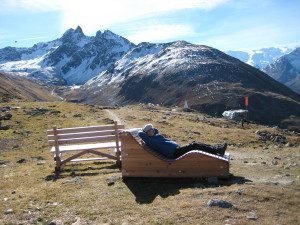
 After you’ve been working hard you need a break. The break might be a vacation, nature hike, or meditation. There are many ways to “get away.” When you come out of a contemplative, quiet state you function differently. You get in touch with your core self.
Contemplation is built into many religious systems. In Judaism the Sabbath day is designed to be a day of peace and holiness. It serves to assist in attaining holiness particularly because the contemplative atmosphere instills peace of mind and the quality of holiness is a seeking of at-peace-ness: to be satisfied with whatever one has, to feel sufficiency with a minimal amount of things and to not be power-hungry but at peace with the world.
In a contemplative, quiet state we enter an entity called ‘self.’ This is the place we are in spiritually when we have consciousness. In our core self we are a harmonious whole. Thus accessing the self brings peace of mind, and peace of mind makes us centered. If we are centered all aspects of the self are integrated and from that ‘core self’ perspective we’re able to distinguish differences between realities in the world.
To reflect this awareness, at the end of the Sabbath day in the prayer-for-consciousness we acknowledge life’s distinctions by saying “You separate between the Sabbath and weekday, between light and darkness…” If we’ve taken advantage of the day’s contemplative power, we’re open to recognizing the potential it has just now offered for just ‘being’ as opposed to the potential for ‘doing’ offered by a regular weekday.
With consciousness you have a self. This can be compared to an electric current with a positive and negative charge. When the connection is made a third entity is created: light. In a similar way the connection between body and soul creates a new entity called ‘self.’
As long as wisdom and actions are split into separate parts the self is missing. We can talk about rationality or intellect but where there is intellect without emotion blended in there is no consciousness. Where there is consciousness we know we’ve reached the essential self.
Consciousness brings together all the various dimensions within you, from the innermost soul to concrete action. It joins the abstract with the practical. An example of this is someone who has made a firm decision about doing something. They’ve connected the dimensions of thought and action and from the time of decision we can consider the thing already done.
The Midrash says that Abraham, father of the Jewish nation before there was a nation, knew the entire Torah before it was given. He knew about the Sabbath and about the ban against derogatory speech about other people and all the rest of the laws even though he lived a long time before the revelation at Sinai. How did he know? He learned it from his core self. If you are truly integrated and get to the ultimate consciousness you will find all of revelation. It’s all within you.
The sanctuary was a building created out of consciousness and the sanctuary within you is also created through consciousness.
The practical applications to this are profound. When something means nothing to you it remains foreign. It’s outside your radar. When something touches you to the core, you immediately act on it. Those individuals who choose to save someone’s life even at great risk to their own do so because they have been touched to the core.
A contemplative state puts you in touch with your core self so that you feel synthesis rather than warring factions. In that place of core self all the parts of you work in perfect harmony.
(from Pirkei Kinyan Da’at)