
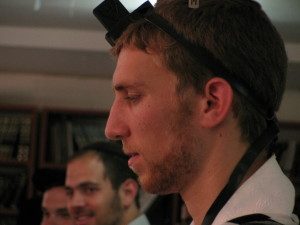
 Ancient acupuncture meridians located on the hairline and base of the skull were considered to enhance consciousness.
Tefilin, the boxes with parchment inside that are worn according to Jewish tradition are placed on those very same points and are likewise considered to serve to raise spiritual consciousness.
“The knot of tefilin rests in a place where the nerve endings of the brain enter the spinal cord. Thus it is the point that connects the spirituality of the head with the spirituality of the body.” (Pirkei Kinyan Da’at p. 69)
By summoning consciousness tefilin is designed to bind mind, heart and action to make up one harmonious integrated personality.
What is the aspect of consciousness that allows knowledge to not just remain in the head but to spread throughout the entire system and turn head knowledge into heart knowledge, creating a whole-body-and-soul awareness?
The pivotal point around which knowledge has the potential to manifest either as arrogance or humility is fear-of-God. Genuine consciousness is rooted in fear of God, which means sensing the presence of God in all of existence to the extent of realizing that no space is empty of God. The imprint of the creator is in all that God created. (Pirkei Kinyan Da’at p. 69)
Knowledge that is limited only to the head goes to one’s head.
Genuine consciousness includes awareness of God’s presence. It follows that you cannot hide from God. By thinking in this way you won’t do anything while looking over your shoulder to check if anyone sees you because as long as you are doing the right thing people’s opinions and judgment will be irrelevant to you, knowing that God sees everything you do and it is to God alone that you are accountable.
This makes it clear that fear of God is not a pathological fear but an essential component of conscience, i.e. awareness of what God wants from you at any given moment. Awareness demands action.
This awareness is so profound that it takes us beyond the question of choice. There are times of such clarity and centeredness that you ‘just know’ what is right. There is no real ‘choice’ to speak of, only a ‘must.’
This is expressed in the Jewish text we’ve been discussing:
“The ultimate choice is when there is a sense that one has no choice, that one must choose what is good.” (Pirkei Kinyan Da’at p. 71)
I call this condition ‘beyond choice.’ No one is forcing you one way or another. Your awareness simply does not allow you to do otherwise.
In a similar way Elisabeth Lukas alludes to this in her discussion of conscience:
In Logotherapeutic terms this experience when achieved optimally is called conscience. “An optimal therapeutic outcome would mean that the patient, in being true to himself reaches a point, ‘where he could not do other than to follow his innermost calibrated conscience according to his own value standard.’ A student of mine who worked in a religious mission in the crises rattled African country of Rwanda once passed me a quotation which fits wonderfully and proves how intercultural Frankl’s view is. The quotation says: ‘A friend is one, who knows the melody of your heart and who recalls it to your memory in case you have forgotten it.’ In reference to this, it could be said that logotherapy is like such a friend.” (Logotherapy textbook, Lukas, p. 61-63)
But are we always so sure? Something to think about…
Please note: Spiritual Independence (June 4) and Emotion-Honoring (June 11) have been reconstructed due to attaining greater clarity after having finished reading the book to the end