

I have just returned from a three week visit to Poland that was extended due to the Iran-Israel war that brought hundreds of missiles to be launched on Israel, some of which were direct hits, 31 people were killed, thousands wounded, many more were displaced from their homes which suffered extensive damage. I had gone to Poland aspiring to a deeply meaningful journey for me, with the Holocaust at the center, remembering family members whose lives were tragically cut short from life, as well as following up on a genuine interest in learning about 1000 years of Polish Jewish history. However, I got more than I bargained for. The situation in which my own children and grandchild back home were in and out of sirens and protected rooms throughout the night, and the entire nation of Israel was on alert for 12 days- all this while I traveled around Poland at my leisure- this was not what I had had in mind nor did it leave me feeling very good about my journey. Nevertheless, in the end, life transpires as it does, we have very limited control of most of what happens, although we prefer to think that we do.
In fact, one of the more fundamental ways in which we do find meaning in our lives, from my own observation, study and reflection, is by means from something deeply ingrained in us by virtue of our humanity- hope. In a world where so much darkness seems to be taking over — wars, terrorism, insane politics, hate, division, natural disasters, despair — it can be easy to give up on hope. Many confuse hope with optimism, but they are not the same. Optimism says, “It will all turn out fine”, but it gives little in the way of practical action and can even at times be downright dangerous. Hope doesn’t promise that. Hope says: I can’t be sure how it will turn out, but I will still act with faith, dignity, and courage. Hope speaks a different language, a language deeply rooted in the human existence.

“Hope” is a profound and powerful human emotion (and a cognitive construct) characterized by anticipation, and belief in the possibility of positive outcomes, even in difficult or uncertain circumstances. Historically speaking, hope has been viewed as both a psychological strength and a liability. Philosophers such as Thomas Aquinas and Soren Kierkegaard, for example, viewed hope as a central virtue while others like Rene Descartes and Friedrich Nietzsche dismissed hope as an irrational and unproductive form of thinking. This same “mixed view” towards the concept of hope can be seen in the evolution of early Zionist ideology which equated hope with a sense of passivity and the lack of agency of Diaspora Jewry, and promoted the Zionist “activist ideology” as the solution for Jews as such. That said, the national anthem of Israel- “Tikvatenu”, means “Our Hope.”
Hope is not a “feel-good” emotion. It is not a wishful thought or naive denial of reality. Hope is a choice. A responsibility. A way of life. It is rooted in a deep commitment to healing, to presence, to action — to Tikkun Olam, the Jewish call to repair the world. And I draw strength from a practice rooted also in Eastern tradition — in Buddhism, the Eightfold Path speaks of right view, right intention, right action — tools that guide us back to what matters. Hope is a discipline, an energy, that lives in that space.
While Viktor Frankl did not often use the word hope directly in a popular or poetic way, much of what he said and taught embody hope as a core element of the human spirit — especially through meaning, future-orientation, and human dignity in suffering.
“There is nothing in the world, I venture to say, that would so effectively help one to survive even the worst conditions as the knowledge that there is a meaning in one’s life.” (Man’s Search for Meaning)
My deceased father, Mordechai Dunetz, survived the Holocaust, losing his entire family except for one sister. He moved on from the abyss to create a meaningful life as an educator, principal, journalist and community leader. He and my mother created a family for which we now have a 4th generation. I would submit that you do not do this kind of thing without two very essential related components in life- meaning and hope.
When I reflect back at when I began to research the second generation, I remember feeling amazed at just how amazing our parents were! I don’t feel the world gave enough credit to the survivors themselves, to their amazing journey from the ashes of their lives to coming to a new world to create life, continuity and growth. While not all survivors were able to do so (there were definitely those who were not psychologically and physically able to overcome their tragedy), the vast majority proved to be amazingly resilient, creative and vibrant.
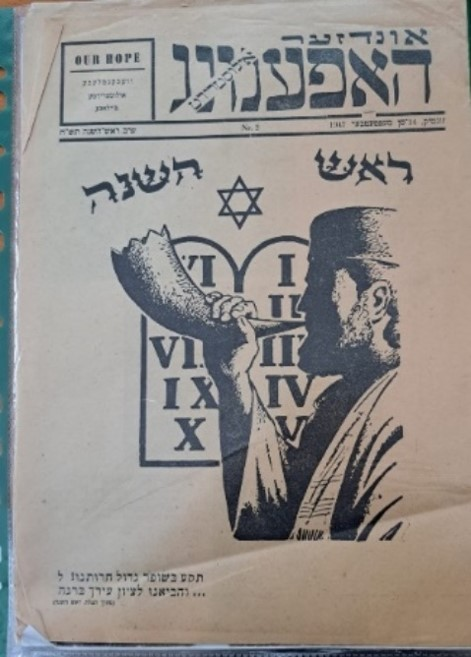
After the Holocaust, my father transitioned to a displaced persons camp in Germany in the city of Eschwege. He became the editor of one of the first Yiddish-language newspapers in the DP Camps in Germany after the Holocaust. It was only quite recently that I took notice of the name that paper was given: “Unzer Hoefunung”, “Our Hope” in Yiddish. I wish my father were here to ask him more about this, and much more…
Hope and meaning lie at the heart of human existence, even in our darkest times.
Ronnie Dunetz has been a life-career-business coach, and group/workshop facilitator since 2004. His workshops focus on the cultivation of hope, meaning as well as “sage-ing”- harvesting of wisdom in later life. At age 64, Ronnie received his Doctorate of Philosophy in Wisdom Studies with the dissertation on Reflections of children of Holocaust survivors in their second half of life on their life experience. He is currently a diplomate candidate writing the thesis: “The Will to Meaning, The Will to Hope: Reclaiming Life After the Abyss.”